Your Cart is Empty



Updated August 2026
A Chelsea boot is an ankle boot with elastic side panels and no laces, pulled on by a heel tab. Buying one pair? Buy a dark brown calfskin Chelsea on a leather sole — it works under a suit, under wool trousers and over denim, which no other boot does as easily. Black is the second pair, not the first.
That answer holds for most men, and the reason is the elastic. A Chelsea has no laces, so the fit is decided entirely by the last — the wooden form the boot is built around — and by how the elastic gore is tensioned. Get both right and it is the fastest correct thing in your wardrobe. Get them wrong and the boot either gapes at the ankle or fights you at the instep, and no break-in period fixes either.
This guide covers what separates a dress Chelsea from a casual one, which colour and material to buy first, which sole to choose, how a Chelsea should actually fit, how to judge whether one is well made, and what a good pair costs in 2026.
Disclosure before we start: Cobbler Union makes Chelsea boots in Almansa, Spain, so we have skin in this game. The comparisons stay honest anyway, including where another maker is the better answer for you.
A Chelsea boot is an ankle-height boot with an elastic gore on each side, a pull tab at the heel, and no laces or buckles. The design dates to 1851, when London bootmaker J. Sparkes-Hall patented an elastic-sided boot for Queen Victoria; the "Chelsea" name arrived a century later, from the King's Road crowd who wore them in 1960s London.
Two things define the silhouette. The unbroken line — no laces crossing the vamp — is what makes a Chelsea read cleaner than any lace-up boot at the same height. The elastic gore is what makes it a slip-on: it stretches to let the foot in, then pulls the shaft back against the ankle.
Everything else varies, and that variation is exactly what separates a boot you can wear with a suit from one you cannot.
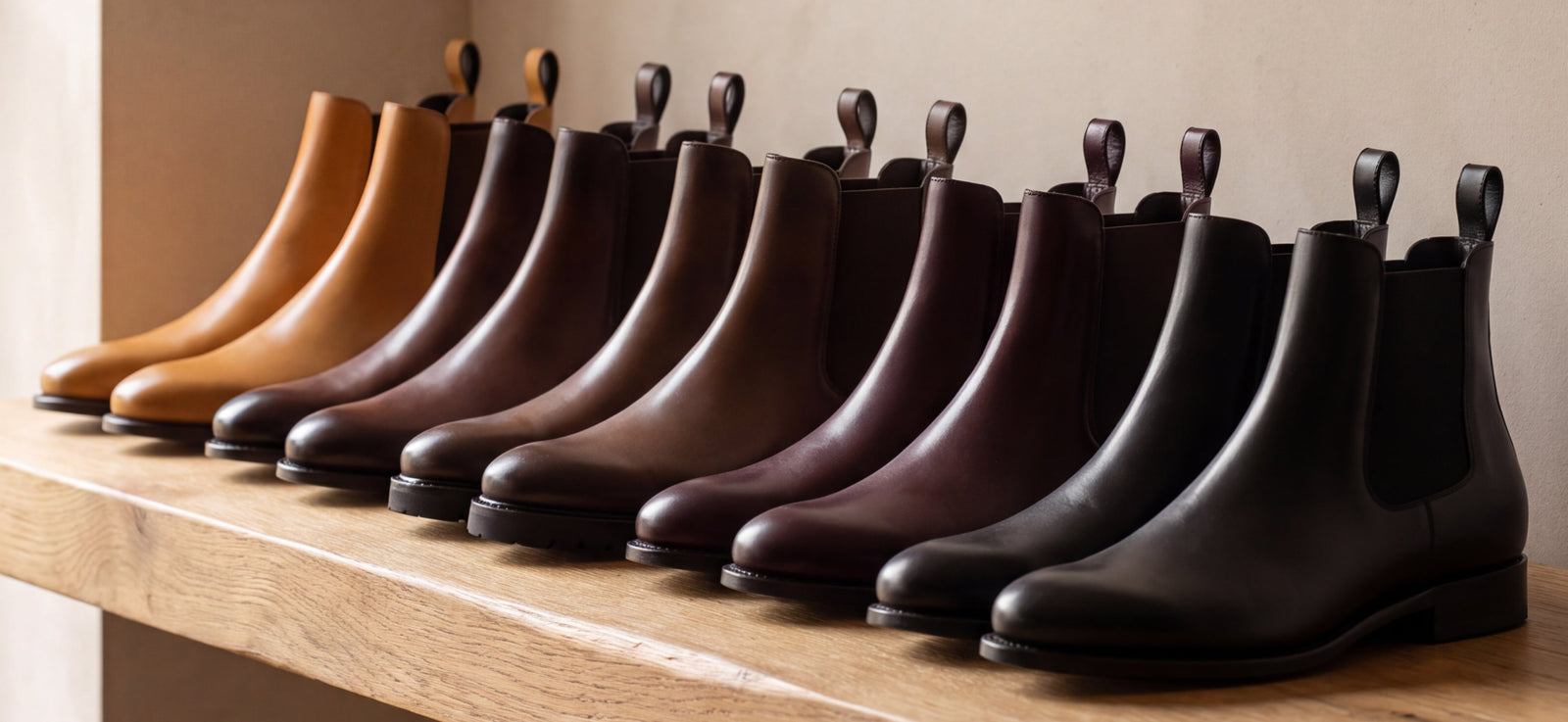
Both exist, and the difference is visible in three details: the toe shape, the sole, and the height of the shaft. A dress Chelsea has a defined almond or chisel toe, a leather or slim rubber sole, and an ankle-height shaft that finishes cleanly under a trouser. A casual Chelsea has a round toe, a thick lugged or wedge sole, and often a taller, looser shaft.
The two are not interchangeable. A round-toed Chelsea on a chunky crepe wedge will not carry a suit no matter how good the leather is — the proportion is wrong at the floor. A dress Chelsea on a leather sole will carry denim perfectly well, which is why it is the more useful of the two to own.
| Dress Chelsea | Casual Chelsea | |
|---|---|---|
| Toe | Almond or chisel, defined | Round, full |
| Sole | Leather, half rubber, or slim rubber | Lugged, crepe, or wedge |
| Leather | Smooth calfskin, polished suede | Oiled leather, rough-out suede |
| Wears with a suit? | ✅ Yes | ❌ No |
| Wears with denim? | ✅ Yes | ✅ Yes |
If you are choosing between a Chelsea and a lace-up dress boot for the office, that comparison is covered in our men's dress boot guide, which sets the Chelsea against balmoral and derby boots side by side.
Buy dark brown first. Black second. Dark brown is the colour that disappears into the most outfits — charcoal, grey, navy, tan and denim all take it — while black is narrower than men expect, correct with grey and charcoal tailoring and awkward with brown or tan anything.
The exception is a wardrobe that skews formal. If you wear a suit four days a week and the suits are grey and navy, a black Chelsea in smooth calfskin earns its place first, and it is the only Chelsea that comes close to business formal.
For a third pair, oxblood is the most rewarding choice. A deep wine-dark red works with grey, navy, charcoal and denim the way black does, then adds character black cannot. Few men own one, which is what makes it read as taste rather than risk.
| Colour | Buy it | Best with |
|---|---|---|
| Dark brown | First | Charcoal, grey, navy, tan, denim |
| Black | Second — or first if you wear suits daily | Grey and charcoal tailoring, black tie-adjacent |
| Oxblood | Third | Grey flannel, navy, raw denim |
| Tobacco / mid-brown | Third or later | Autumn tailoring, brown and bronze, denim |
| Navy | Later — a quieter substitute for black | Grey, tan, denim |
Buy calfskin first and suede second. Smooth calfskin is more formal, easier to keep, and the only version that carries a suit without hesitation. Suede is softer, warmer in texture, and reads correct with denim, chinos and flannel — but it stops at the office door in a conservative room, and it needs protecting before its first wear.
Calfskin also holds a shine, and on a Chelsea that matters more than on a lace-up: the unbroken vamp is a large uninterrupted surface, so a good finish shows and a poor one shows just as clearly.
Suede's practical objection is water, and it is smaller than its reputation. A protective spray before the first wear and a rubber brush afterwards handles ordinary weather. What suede does not forgive is salt, which is a real consideration in a winter boot.
A full leather sole for a dress Chelsea, a rubber half-sole if you commute on foot, and a lugged commando sole only if you want a boot for genuinely bad weather. All three can sit under the same boot without changing how it reads above the ankle — the sole is the one component you can choose purely on how you live.
| Sole | Grip | How it reads | Buy it if |
|---|---|---|---|
| Full leather | Low | Dressiest | The boot's job is tailoring and dry pavement |
| Rubber half-sole | Good | Unchanged from leather | You walk to work and want the dress look intact |
| Dainite-style studded rubber | Good | Slightly sturdier | You want all-weather grip with a low profile |
| Commando (lugged) | Highest | Rugged, taller stance | Snow, ice, cold streets |
The half-sole deserves the attention it rarely gets. A discreet high-density rubber half-sole sits under the forepart only, leaves the waist and heel in leather, and is invisible in every situation where the boot is being looked at. It is the sole most men should buy and the one they most often skip.
We cover the full trade-off in leather vs rubber soles, including how each one wears and what a resole costs you in practice.
A Chelsea should fit snugly at the heel and the instep, with the elastic under mild tension when the boot is on. There should be no visible gap between the shaft and your ankle, and no piston movement at the heel when you walk. Length is judged the same way as a dress shoe: a thumb's width beyond the longest toe, with the ball of the foot sitting at the widest part of the last.
The elastic is what makes Chelsea fit unforgiving. On a lace-up boot, laces correct for a foot that is narrower or higher than the last assumes. A Chelsea has no such adjustment — so the last has to be right for your foot from the start.
That is why the same boot on two different lasts is not the same purchase. Our Bennett Chelsea is built on two:
| 722 last | 675 last | |
|---|---|---|
| Toe | Slight chisel, long and lean | Almond, rounder and more classic |
| Toe box | Closer-cut | Deeper — more room over the toes |
| Reads as | Sharper, more modern | Quieter, traditionally English |
| Choose it if | You want the sharpest line under tailoring | You have a fuller foot, a higher instep, or you're on your feet all day |
If your usual dress shoe pinches across the top of the foot, or you size up in most brands to get width you don't actually need in length, the rounder last with the deeper toe box is the one to try. A full explanation of how lasts drive fit is in our guide to choosing the right last.
Two fitting notes specific to Chelsea boots:
Three things, in this order: the leather, the construction, and the finishing.
Leather comes first because it is the only component you cannot upgrade later. The question that matters is full-grain versus corrected grain. Corrected grain is sanded to remove scars, embossed with a printed grain, then sealed under pigment — it looks perfectly even on day one and it cannot develop patina, because the surface you're polishing is a coating rather than the hide. Full-grain calfskin looks slightly less uniform on day one and better every year after. On a Chelsea, where the vamp is one large unbroken panel, this difference is more visible than on almost any other boot.
Construction is second. A Goodyear welt stitches the upper and welt to a leather insole, then stitches the sole to the welt — which is what allows the sole to be renewed without disturbing the upper. Look for a leather insole rather than a foam one, a full leather lining, and a firm heel counter you cannot fold with your thumb. Our Bennett is Goodyear welted by our artisans in Almansa, one pair at a time, on a leather insole and a full leather lining. The mechanics of the construction are explained in what Goodyear welted actually means.
Finishing is third, and it is where price shows fastest. On a well-made Chelsea the elastic gore is set flush with the leather rather than proud of it, the pull tab is stitched through rather than glued on, the sole edge is trimmed close and burnished dark, and the colour has depth — hand-burnished darker at the toe and heel so it moves in the light instead of sitting flat.
A dark brown or black dress Chelsea works under a suit, under wool trousers with a jacket, and over straight or slim denim. The rule that governs all three is the trouser opening: it has to close over the shaft. A wide or cropped trouser that exposes the elastic gore breaks the line and makes the boot read as a mistake rather than a choice.
| Outfit | Chelsea to wear |
|---|---|
| Navy or charcoal suit | Black or dark brown calfskin, leather sole, defined toe |
| Wool trousers + unstructured jacket | Dark brown or oxblood calfskin |
| Chinos | Brown, tobacco or suede |
| Raw or dark denim | Brown, oxblood, tobacco — suede works here too |
| Overcoat weather | Any of the above on a rubber half-sole or commando |
One thing a Chelsea does that a lace-up boot cannot: it holds a clean line under a slim trouser without a break in the silhouette, because there is nothing crossing the vamp. That is the entire reason the boot survived from 1851 to now.
Chelsea boots are made well at several price levels. The map looks roughly like this:
If you want a boot that is cut from one piece of leather with no heel seam, buy the R.M. Williams — nothing here substitutes for it. If you want a round-toed English boot in the Northampton tradition, buy the Loake or the Crockett & Jones. What we build is a Chelsea with a sharper European line, a choice of two lasts, and hand-burnished colour, made in a workshop rather than a factory.
Price tracks construction and leather before it tracks anything else. A welted Chelsea in full-grain calfskin, made in a European workshop, sits in a different bracket from a cemented boot in corrected grain — and the two can look identical in a photograph, which is why the spec matters more than the number.
Our own Chelsea boots start at $515 at list price — the Bennett in top-grade European calfskin, on either last, with your choice of leather, half-rubber, Dainite-style or commando sole. That price is the outcome of shipping direct from the workshop in Almansa rather than through a distributor and a retailer, not of cutting the leather or the construction.
Two things worth knowing about the money:
1. The sole is the cheapest part to renew and the most expensive to get wrong. A welted boot's sole can be replaced several times; a cemented one usually cannot be replaced at all.
2. Colour depth costs labour, not materials. Hand-burnished colour takes an artisan's time. It is also the difference most visible from three feet away.
Yes, if the boot is a dress Chelsea — a defined almond or chisel toe, smooth calfskin, and a leather or slim rubber sole. A black or dark brown dress Chelsea is correct with a navy or charcoal suit in almost every business setting. A round-toed Chelsea on a lugged or wedge sole is not, regardless of the leather.
Yes. New elastic is at its tightest, and a Chelsea that pulls on easily on day one will gape at the ankle within a few months. A new pair should take real effort at the heel while still fitting correctly in length, with the ball of your foot at the widest part of the last. The elastic relaxes; the leather does not lengthen.
They can be, but the last decides it, not the size. Because a Chelsea has no laces to let out, a wide or high-instep foot needs a last with a deeper toe box and a rounder toe rather than a longer size. Sizing up to gain width gives you a boot that is too long and slips at the heel — the one thing a Chelsea cannot tolerate.
A Chelsea is more versatile upward, a chukka more versatile downward. The Chelsea's unbroken line carries tailoring more comfortably; the chukka, with its two or three eyelets and softer construction, sits more naturally with chinos and casual wear. If you own one boot and wear suits, buy the Chelsea. Both are compared against lace-up dress boots in our dress boot guide.
Brush off dry dirt, clean the leather with a damp cloth or a dedicated leather cleaner, let it dry away from heat, then condition and polish. The one part specific to a Chelsea is the elastic gore: keep cream and polish off it, because conditioners degrade elastic over time. Our step-by-step leather cleaning guide covers the full routine.
A Goodyear welted or Blake-stitched Chelsea can be resoled, usually several times. A cemented one — where the sole is glued rather than stitched — generally cannot be resoled in a way that lasts. If you plan to keep a boot for years, the construction is what decides whether that is possible.
Dark brown. It works with charcoal, grey, navy, tan and denim, which covers most of what men actually wear. Black is more formal but narrower in range, and it clashes with brown and tan tailoring. If you are buying one Chelsea boot and only one, buy it in dark brown calfskin.
The leather relaxes slightly across the vamp, and the elastic gore loses tension with wear — which is why a new pair should be snug. Cedar shoe trees inserted after each wear help the shaft keep its shape and the vamp stay flat. When the elastic eventually goes slack, a good cobbler can replace the gores without rebuilding the boot.
The Chelsea has been in continuous production since 1851 and has never left menswear for long. The silhouette that moves is the casual one — wedge soles and taller shafts come and go. A dress Chelsea with a defined toe and a leather sole has looked the same for decades, which is the practical argument for buying that version rather than the seasonal one.