Your Cart is Empty



Updated August 2026
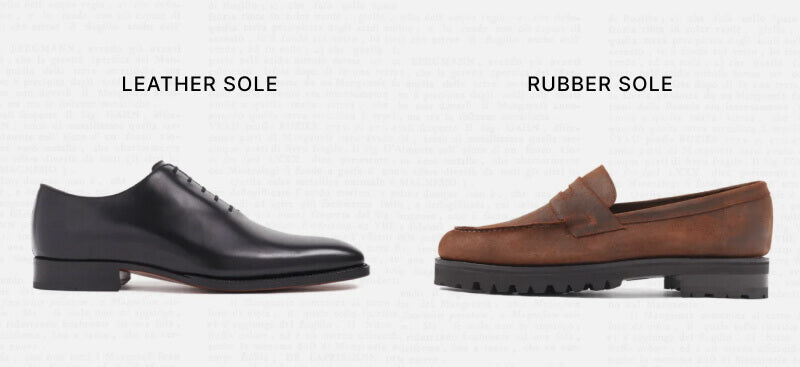
Choose a leather sole for formal shoes worn indoors, and a rubber sole for anything that meets weather, distance or hard pavement. Leather is more elegant, breathes better and can be renewed; rubber grips better, lasts longer and needs no breaking in. A combined half-rubber sole gives you the leather look with rubber traction where the foot actually lands.
With so many options for shoe styles, leathers, and shapes, no choice is going to affect your day-to-day wear like the soles.
Between rubber soles vs leather soles, it’s natural to ask: “Which type of sole is the best choice?”Of course, the answer comes down to the old familiar - it depends.
That said, we’re here to give you the information you need to know to pick the right option for you. Whether you’re eyeing Vibram sole shoes or double leather soled brogues, tie those laces tight and let’s get right into it.
Leather has been a go to shoe material for thousands of years. Think about it. Ancient artists don’t put Greek gods in leather sandals as a reference to modern fashion. From Greek sandals to French kings to dandy Brits, the leather sole history is massive.

Entering the 18th century, leather tanning technology and machinery continued to evolve to the point where consistent commercial leathers could finally be produced and sold.
Leather has remained popular today for dress shoes. There’s a lineage of formality and tradition that has an undeniable charm. Hides are available, breathable, and durable, all qualities that make them still a perfectly suited material for soles.
These first came into play in the late 1800s by the Continental rubber company as a durable, lightweight alternative. With vulcanized rubber technology, they really became ubiquitous after World War I for all kinds of footwear.
Rubber soles continued to be refined through different chemical compositions for lightness and traction. The performance qualities for outdoor activities and sports are obvious, but they’ve worked their way into formal wear as an alternative to leather.
| Leather Sole | Rubber Sole | Combined | |
| Durability | Resilient | Stronger choice | Durable |
| Comfort | Initially Stiffer * | Extra shock-absorption | Flexible |
| Elegance | Super Elegant | Casual Dress | Versatile |
| Weight | Normal | Light / Ultra Light | Normal |
There’s a reason leather and rubber soles have remained extremely popular. They both have a slew of strengths that keep them relevant in the shoemaking world.
Let’s break the leather soles vs rubber sole differences into different categories for their pros and cons.
Rubber is the clear winner for a long lasting sole. But let's explain both to better understand each type.
People always ask us “are leather soles durable?”. Although they’re resilient, they aren’t nearly as hardy as their rubber counterparts.
Generally, leather soles will be used in formal or office settings. They’re excellent picks for tying together a look with a suit and for that Fred Astaire glide at the wedding reception, but will wear down much more quickly if you’re walking through the city to work everyday or hitting the town in the evenings.
It’s crucial to note that wet weather is not kind to leather soles. Rain, snow, and the salt used on roads for ice can eat away at the hides, so it’s smart to have a rubber-soled option on deck to stay prepared.
Durability might be the absolute greatest benefit of rubber soles.
People use rubber for work boots, for tennis courts, for long distance running, and everything else where a pair needs to stay together. With rubber, you’ll be set for a very long time.
Rubber soles are also extremely weather resistant. Wear a pair and stomp through the puddles all you want, or pick a rubber sole for ice and you’ll be much better off.
Comfort is more subjective between the two. It depends fully on preference.
Leather soles are generally a bit stiffer out of the box. However, that doesn’t mean they lack comfort. Leather soles will flex to your gait and conform to your foot with use. With the combination of a layer of cork in Goodyear welted shoes, leather soles can give the closest thing to fully customized foot bed with wear.
Rubber soles will almost always feel more flexible on first wear. There’s a natural level of cushion that gives extra shock-absorption, and lighter rubber options can give a shoe a sneaker-like feeling.
Leather is a classic and the king of elegance in shoe soles.
Leather soles are pure elegance. The aesthetic values might be the top reason leather soles have stuck around as long as they have. The look cannot be replicated by anything else.

The soles age gracefully with wear, and there’s something poetic about the personalized scuffs one develops over time.
Leather soles are also low-profile and inconspicuous. They don’t distract from an outfit and have a strong formal message. They’ll always have a place anywhere you want to signal your professionalism or elegance.
Rubber sole dress shoes don’t instantly make it inelegant, but they are more associated with casual dress.
Many low-profile rubber soles are available that are perfectly suited for formal dress. Many other rubber soles will make it look like you left your hiking boots on. We feel we can trust you to know the difference between these extremes.

Rubber sole material for shoes comes in many different forms: tread varieties, composition, thickness, weight. One thing that remains consistent with rubber soles is their traction, durability, and flexibility. All these qualities make a rubber sole boot or shoe an excellent pick.
Here are a few of the most common rubber sole options you’ll find for Goodyear welted shoes and boots.
The most durable option, the composition of rubber is very high relative to other options, providing an extremely durable, grippy surface to work with. Note they’re a touch heavier than the rest.

Gumlite is one of Vibram’s performance rubber sole lines. They’re soft, lightweight, and built with larger treads for improved grip.
Gumlite soles use a rubber and EVA compound to create a lighter material. They’re an excellent type of sole for boots, but have crossed over into formal shoes for a unique look.

Blown, or injected, air rubber soles are some of the lightest rubber sole options available. They’re made by injecting air into the rubber during processing and are exceptionally light, flexible, and cushiony. The feel is almost sneaker-like.
The Vibram Christy wedge sole is the most popular blown air sole available in Goodyear welted shoemaking.

In our collection, we have several options for rubber soles to fit the occasion.
Full rubber soles offer full coverage of the bottom of the shoe. We use combinations of high-density rubber for the best durability and grip, and more low-profile rubber and EVA combination options for a sleek, formal look.

If you can’t pick one or the other, why not take both?
Hybrid leather and rubber soles have the same elegant benefits of a leather sole, but are substantiated with rubber where your foot hits the ground on the ball to the toe and heel.

Ultralight rubber soles are generally considered performance soles. They’re extra light, extra comfortable, but still very durable. These cushiony soles are the closest you can get to a sneaker feel with a stitched on sole.
Although they’re typically associated with work and performance footwear, they’ve worked their way into formal shoemaking. For us, that’s worth celebrating.

Absolutely! Whether it’s a rubber or leather sole, as long as the pairs are Goodyear welted the soles can be replaced time and time again to extend the life of a pair.
For your replacement options, you’re at the mercy of what’s available at your local cobbler. Fortunately, trusted brands like Vibram and Dainite have found massive popularity and are carried by a majority of shops.
Although you can always find somebody that’s willing to replace a sole for you, that doesn’t mean you should always let them do it.
When considering using a local repair service, we always recommend three quick checks.
We always recommend checking your local options first to support a small business. However, if one’s not available for your Vibram sole replacement, here are a few popular and trusted options that take on sole repair services through mail.
Ansley Shoe Repair - Atlanta, GA
Bedo’s Leatherworks - Falls Church, VA
Potter & Sons - Nashville, TN
Cobblers Plus - Denver, CO
Vibram is a world-renowned Italian rubber sole manufacturer that has been crafting some of the highest quality products since 1935. At Cobbler Union, we couldn’t be prouder to be official partners with them.
Vibram was founded by the Italian mountaineer Vitale Bramani in the 1930s. After several of his companions passed away after slipping during a difficult climb, he patented his pair of treaded rubber soles to conquer the mountain and the rest is history. Vibram sole boots are famous as the boots that conquered Everest.
Since then, they’ve continued developing rubber sole technology and have branched out from mountain climbing to formal wear and everything in between. These days, the yellow octagonal Vibram logo is seen as a sure sign of high quality.
Vibram is trusted for a reason:
Give the Cobbler Union rubber sole collection a peek and see what our partnership with Vibram has to offer.

Match the sole to where the shoe will actually spend its life, not to how formal you want it to look. Most men own the wrong sole because they buy for the dressiest occasion rather than the most frequent one.
| Leather sole | Rubber sole | Half-rubber (combined) | |
|---|---|---|---|
| Formality | Highest | Lower | Reads as leather |
| Grip on wet ground | Poor | Best | Good — rubber sits at the forefoot |
| Breathability | Best | Limited | Good |
| Break-in | Stiff at first | Flexible immediately | Moderate |
| Wear rate | Faster | Slowest | Slow where it matters |
| Can be renewed | Yes, if welted | Yes, if welted | Yes, if welted |
| Best for | Weddings, offices, indoors | Commuting, rain, travel, city miles | One pair that does both |
The decision in one line: if the shoe will be worn more than twice a week outdoors, buy rubber or half-rubber. A leather sole worn daily on pavement will need renewing within a year, which is a cost and an inconvenience rather than a flaw.
A half-rubber sole is a leather sole with a thin rubber section set into the forefoot, where almost all of the wear and slipping happens. From the side the shoe still reads as a leather-soled dress shoe; underfoot it grips like a rubber one.
It is the answer for the man who wants one pair rather than two. The heel and waist stay leather, so the shoe keeps its slim profile and the waist can still be beveled. The rubber section takes the abrasion, which means the leather underneath lasts considerably longer before a resole is needed.
Cobbler Union offers half-rubber on several models, including the Smith penny loafer, at $465 for most loafers and $490 for most shoes. For how sole choice interacts with loafer styles specifically, see our men's leather loafer guide.
Leather soles are not ruined by rain, but they are genuinely poor in it: wet leather grips badly and wears far faster than dry leather. The risk is slipping, not destroying the shoe.
Three things that help, in order of effect:
What does not help: waterproofing sprays made for uppers. They do nothing useful for a sole.
A leather sole worn twice a week typically lasts one to three years before it needs renewing; a rubber sole under the same use commonly lasts several years longer. The range is wide because the variables are your gait, your pavement and your rotation, not the sole itself.
The number that actually matters is different: whether the sole can be renewed at all. On a Goodyear welted shoe, the sole is stitched to a welt rather than glued to the upper, so it can be replaced repeatedly without disturbing the shoe — which is why a welted pair can outlast several cemented ones regardless of which sole it started with. Our guide to Goodyear welt construction explains how that works.
Cobbler Union shoes are Goodyear welted by our artisans, one pair at a time, in a workshop in Almansa, Spain — in leather, rubber and half-rubber. The rubber options are built with Vibram, the Italian sole maker, whose compounds are what make a lightweight rubber sole possible without the bulk of a work boot.
Between leather and rubber soles, the most important thing is to know your options and your purpose.
The best option is to have a pair of both. Trust us, with both options you’ll always have a reason to bring them out.
Neither is better in general — they are better at different things. Leather is more formal, breathes better and looks more elegant. Rubber grips better, lasts longer and needs no breaking in. Choose leather for formal indoor wear and rubber for weather, commuting and distance.
Yes for formal shoes worn mostly indoors, where their elegance and breathability matter and the wear rate is low. For a shoe worn outdoors several times a week, a rubber or half-rubber sole is the more practical choice and costs less to maintain.
No. Rubber is more durable and wears more slowly than leather under the same use. Leather soles worn twice a week typically need renewing within one to three years. What matters more than the material is whether the shoe is welted, because a welted sole can be replaced repeatedly.
Leather soles grip poorly when wet and wear much faster in rain, but they are not destroyed by it. Rotate pairs so a wet sole can dry, use cedar shoe trees, and consider a thin rubber protective layer or a half-rubber sole if you walk outdoors regularly.
A half-rubber sole is a leather sole with a rubber section set into the forefoot, where most wear and slipping occur. The shoe still reads as leather-soled from the side but grips like a rubber one, and the leather underneath lasts longer before needing a resole.
Yes, provided the shoe is Goodyear welted or Blake stitched. On a welted shoe the sole is stitched to a welt rather than glued to the upper, so it can be replaced repeatedly. Cemented shoes, where the sole is glued on, generally cannot be resoled economically.
Yes, in most modern settings. A slim rubber sole on a well-shaped last reads as a dress shoe; a chunky lug sole does not. For black tie and the most conservative formal occasions, a leather sole is still the correct choice.
Vibram is an Italian rubber sole manufacturer whose compounds are used across dress and outdoor footwear. Its lightweight constructions allow a rubber sole slim enough for a dress shoe, rather than the bulk associated with work boots.