Your Cart is Empty



Updated August 2026
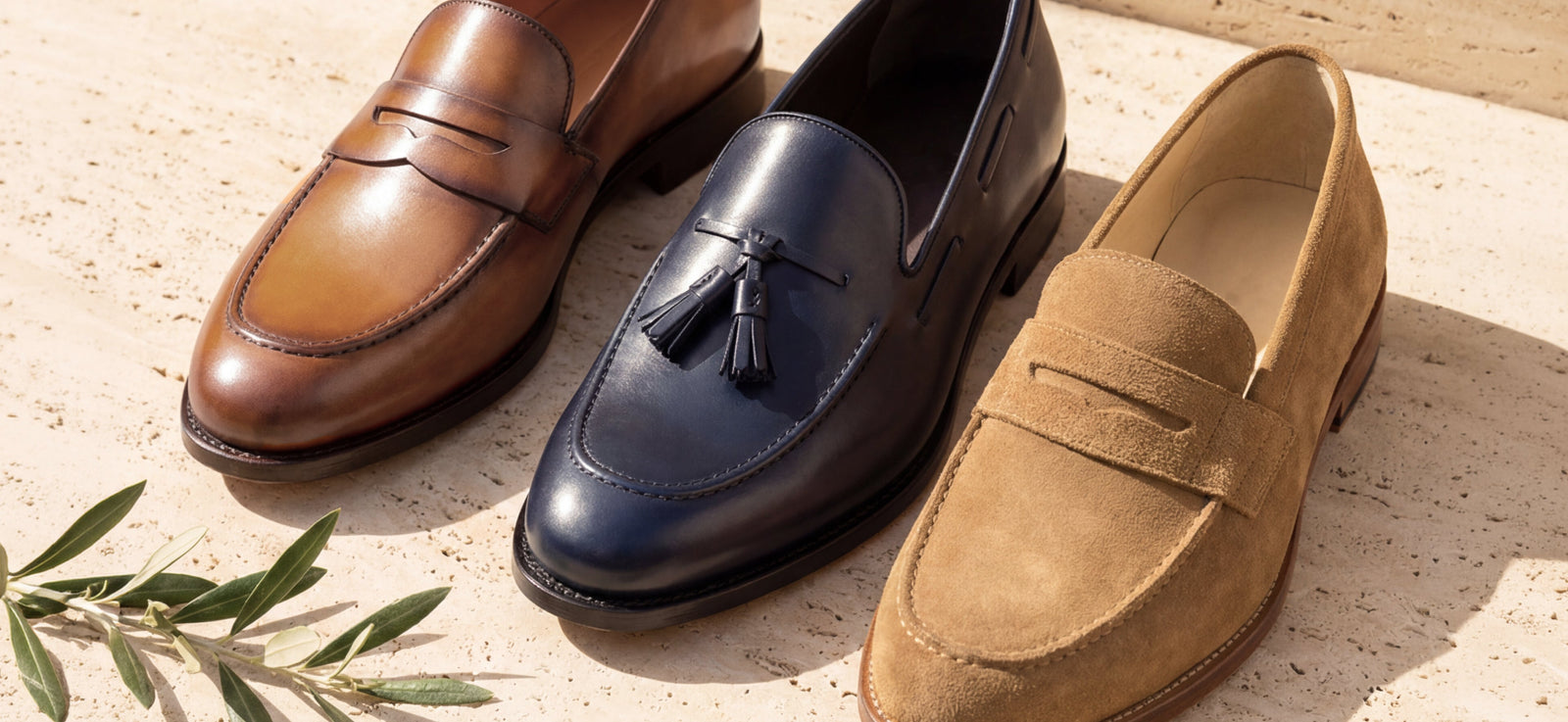
A leather loafer is a slip-on dress shoe with no laces. Three styles cover everything most men need: the penny loafer (the everyday default), the tassel loafer (dressier, with more character), and the Belgian loafer (soft and unstructured, for evening). Buying one pair? Buy a dark brown penny loafer — the most versatile slip-on there is.
That answer holds for most men, but the reason it holds is worth understanding. A loafer has no laces, which means the fit comes entirely from the last — the wooden form the shoe is built around. Get the last right and a loafer is the most comfortable dress shoe you own. Get it wrong and it slips at the heel or bites across the instep, and no amount of breaking in will fix it.
This guide covers which loafer to buy, what each style is actually for, how to fit one to your foot, what a well-made pair costs in 2026, and which makers are worth your money — including several that are not us.
Disclosure before we start: Cobbler Union makes loafers in Almansa, Spain, so we have skin in this game. The comparisons stay honest anyway, including where another maker is the better answer for you.
Four styles account for nearly every men's leather loafer sold:
A fifth category exists — the horsebit loafer, with a metal snaffle across the vamp — but it is closely associated with a single Italian house, and buying one means buying into that reference whether you intend to or not.
Buy the penny loafer first, the tassel second. The penny is quieter and goes under more outfits; the tassel is dressier in a specific, slightly formal register and reads as a deliberate choice rather than a default.
The practical difference is how much attention the shoe asks for. A penny loafer under a navy suit reads as correct and moves on. A tassel loafer under the same suit reads as chosen — it carries a bit of old-school confidence that some men want and others would rather avoid.
The second difference is range. A penny loafer in dark brown calfskin covers a suit, chinos, and dark denim without changing register. A tassel loafer covers the suit and the chinos comfortably, but pairs less naturally with denim.
| Penny loafer | Tassel loafer | Belgian loafer | |
|---|---|---|---|
| Formality | Dressy, neutral | Slightly dressier, characterful | Evening / occasion |
| Best with | Suit, chinos, dark denim | Suit, flannel, chinos | Tuxedo, velvet, dark tailoring |
| First pair? | ✅ Yes | Second pair | Third or later |
| Colour to start | Dark brown | Black or oxblood | Black |
| Typical quality range | $400–700 | $400–700 | $400–600 |
For business casual, a dark brown or black penny loafer in smooth calfskin with a leather sole is the safest and most versatile answer. It works with chinos, wool trousers and an unstructured jacket, and it stays correct if the day turns into a client meeting.
Three rules make a loafer read as office-appropriate rather than weekend:
1. Slim last, defined toe. An almond or chisel toe reads considered. A full round toe drifts casual fast.
2. Smooth calfskin over suede, if the office skews conservative. Suede is correct in most modern offices but reads softer, and in summer it reads best in tan or camel.
3. Leather sole, or a discreet slim rubber one. A chunky lug sole under a dress trouser undoes the whole silhouette.
Colour order for an office rotation: dark brown first, black second, oxblood third. Dark brown is the one that disappears into the most outfits; oxblood is the one people notice and remember.
Our Smith penny loafer is built for exactly this use: top-grade European calfskin, on the 675 last if you want the roomier almond toe, or the chisel-toed 722 if you want a sharper line. It is made by our artisans in Almansa, Goodyear welted, one pair at a time, on a full leather sole — which is also why its sole can be renewed rather than replaced.
Dark brown is more versatile; burgundy (oxblood) is more memorable. If this is your first or second loafer, buy dark brown. If you already own brown and black, oxblood is the most rewarding third pair.
Dark brown works with navy, grey, charcoal, tan and denim — that is most of what most men wear. It is the colour that asks nothing of the rest of the outfit.
Oxblood works with the same range, and adds character black cannot. It reads serious in low light and comes alive in daylight. Its reputation for being risky is overstated: few men wear it, which is precisely why it lands as taste rather than as a gamble.
The detail that separates a good brown from a flat one is depth. On our Henry penny loafer the colour is hand-burnished — an artisan builds it deeper at the toe and heel, so it shifts between chestnut and tobacco as the light moves. A single flat coat of pigment looks the same in every light, which is exactly the problem. The Museum calf version goes further still: the hide is hand-painted at the Ilcea tannery in Italy before the shoe is ever cut, which is where its antiqued, mottled depth comes from.
Because a loafer has no laces, fit comes entirely from the last — so the right question is not "what size?" but "which last?" Most makers publish neither. Here is our full loafer last range with the real fit of each:
| Last | Toe shape | Fit | Instep | Sizing | Best for |
|---|---|---|---|---|---|
| 435 | Oval, full | Very roomy | Medium-low | True to size | Wide feet and high insteps; all-day comfort |
| 675 | Almond, generous | Roomy | Medium | True to size | Most feet; long days |
| 722 | Chisel | Snug | — | True to size | A sharp, modern line under a dress trouser |
| 144 | Elongated almond | Snug | Low | True to size | Low insteps, narrow feet, dress trousers |
Read it against your own foot:
One sizing note that catches most American buyers: Cobbler Union sells in UK sizes, which run one full size below US. A US 10 is a UK 9. Check the size and fit chart before ordering, and see our guide to choosing a last for how last shape works across the whole catalogue.
Comfort in a loafer comes from three things, in this order: the last, the sole, and the lining — not from cushioning. A well-shaped last holds the foot without pressure points; a flexible sole lets the shoe move with you; a full leather lining absorbs moisture instead of trapping it.
That order matters because it is the opposite of how comfort is usually sold. Foam insoles compensate for a last that does not fit. A last that fits does not need compensating.
For city walking, a slim rubber sole outperforms leather on wet pavement and on distance. Our Peter loafer is built for that case: the 435 last — oval-toed, very roomy, with real width across the sides — on a lightweight rubber sole. It is the pair for the man who wants a loafer that goes on without thinking and stays comfortable through the day.
For a desk-based day, a leather sole is the more elegant answer and breathes better. Rotate two pairs rather than wearing one daily: leather needs a day to dry out, and a loafer worn every day without rest will age roughly twice as fast.
Loafers with a full leather lining and a leather insole handle sockless wear best, because leather absorbs moisture where synthetic linings hold it against the skin. That is what causes both blisters and odour.
Three things reduce blistering:
1. Full leather lining. Check that the inside of the heel and the vamp are lined in leather, not a synthetic backing.
2. A last that actually fits your instep. Most sockless blisters come from the shoe sliding at the heel, which is an instep and heel-fit problem, not a sock problem.
3. No-show socks made of cotton, not nylon. They defeat the point visually but solve the problem functionally.
Suede is the more forgiving material sockless — the nap does not stick to damp skin the way a smooth finish does. A camel or tan suede penny loafer is the summer version of this shoe, and it reads warm and considered against a linen or cotton trouser.
Not all suede is equal, and the difference is the tannery. Our suede Peter loafers use English suede from Charles F. Stead, the Leeds tannery that has been making suede since the 1890s and supplies much of the industry's best. A dense, consistent nap is what separates a suede that ages well from one that goes shiny at the flex points within a season.
Three things tell you almost everything, and you can check all of them in about thirty seconds: the leather, what is inside the shoe, and the finishing. Price follows those three; it does not replace them.
Full-grain calfskin keeps the natural surface of the hide; corrected grain has been sanded smooth and sprayed with pigment to hide its flaws. Corrected grain looks flawless on day one and then cracks along the flex points across the vamp, because the coating moves differently from the leather underneath. Full-grain creases instead of cracking, and the creases become the shoe's character.
Look at the vamp in raking light. Full-grain shows fine, irregular pores and slight variation across the surface. Corrected grain looks like plastic film: perfectly even, slightly cold, with a repeating pebble stamped into it.
The tannery matters as much as the grade, and the good ones are nameable. Our smooth calfskin is top-grade European calf; our suede loafers use English suede from Charles F. Stead in Leeds, tanning since the 1890s; and the museum calf is hand-painted on the hide at the Ilcea tannery in Italy, which is where its antiqued depth comes from. If a maker will not tell you where the leather comes from, that is usually the answer.
Reach inside and feel the heel and the footbed — this is where cost gets cut, because nobody photographs it.
Finishing is where attention to detail either exists or does not, and it is the easiest thing to inspect.
| Check | Well made | Built to a price |
|---|---|---|
| Leather surface | Fine irregular pores, slight variation | Even stamped grain, cold plastic look |
| Colour | Hand-burnished, deeper at toe and heel | Flat and uniform |
| Lining | Full leather | Synthetic backing |
| Insole | Leather | Printed fibreboard |
| Heel counter | Firm, springs back | Folds flat |
| Stitching | Even length and spacing throughout | Drifts on the curves |
| Sole edge | Trimmed, burnished, even | Rough or thickly painted |
Our loafers are made by our artisans in a workshop in Almansa, Spain, one pair at a time, in top-grade European leathers with full leather linings and insoles — which is what the $465 buys, rather than a name on the insole.
For a black-tie-optional wedding, a Belgian loafer in black calf, patent or velvet is correct; a sleek black penny loafer is acceptable in most modern interpretations. For strict black tie, wear an oxford or an opera pump — a loafer is not the right shoe.
For everything below black tie, loafers are firmly appropriate:
If you are the groom, the deciding factor is usually the length of the day: a loafer you can slip off under the table is a real advantage over eight hours. Our wedding shoe guide covers the full range by role and dress code.
If you want the look of an Italian loafer without the Italian price, the strongest alternatives come from Spain and England — where the same construction and comparable leathers cost meaningfully less because you are not paying for a fashion house.
Ranked by what each does best:
The pattern worth noticing: the makers who beat Italian pricing are almost all selling either direct or through fewer intermediaries. Construction quality across this list is broadly comparable. What varies is finishing, last selection, and how much of the price is brand.
Yes — Spain is one of the three centres of European welted shoemaking, alongside England and Italy, and Spanish makers generally offer the best construction-per-dollar of the three. The reason is structural, not sentimental: Spanish shoemaking towns kept their craft workshops while other regions industrialised or moved upmarket.
Two towns matter for loafers. Almansa, in Albacete, is where Cobbler Union produces, and is a centre of Spanish welted production. Inca, in Mallorca, is home to Carmina and several others.
What Spanish makers do not have is a century of marketing behind them, which is exactly why the same shoe costs less. Our guide to Spanish shoe brands covers the full landscape, including the makers we compete with.
A well-made leather loafer with full-grain calfskin and a full leather lining costs between $400 and $700 in 2026. Below $200, expect corrected-grain leather and a synthetic lining. Above $800, you are largely paying for brand.
| Price (list) | What you get |
|---|---|
| Under $200 | Corrected-grain leather, synthetic lining, printed insole. Comfortable at first, then it cracks. |
| $200–350 | Full-grain leather, leather lining, simpler finishing and less last variety. |
| $400–700 | Full-grain calfskin from named tanneries, leather lining and insole, hand-burnished colour, considered lasts. |
| $800+ | The above, plus rarer leathers and, increasingly, brand. |
Cobbler Union loafers are $465 for most models, with the range running $420 to $530 depending on the leather and the finish. That sits in the middle of the band above because we sell direct: there is no wholesale markup between the workshop in Almansa and your door. Our guide to what you get under $500 breaks down what each price band actually buys, across brands.
Condition calfskin loafers every 10 to 15 wears, and brush them after each wear. Conditioning replaces the oils that leather loses as it flexes; brushing removes the dust that dries it out in the first place.
A working routine:
1. After each wear — brush with a horsehair brush and insert cedar shoe trees while the shoe is still warm. Cedar absorbs moisture and holds the shape; this single habit does more for a loafer than anything else.
2. Every 10–15 wears — clean, then apply a leather conditioner or renovator and let it absorb before brushing off. We use and sell Saphir Médaille d'Or, made in France since 1920, because it is formulated with natural waxes and oils rather than silicone — silicone seals the leather instead of feeding it, which is the opposite of what conditioning is for.
3. As needed — a pigmented cream polish to restore colour, and wax only on the toe and heel if you want shine.
Suede is different: brush with a crepe or brass brush, treat stains with a suede eraser, and protect with a spray before first wear rather than after the first mark. Our step-by-step leather cleaning guide covers the full process for calfskin.
| If you want… | Buy | Colour |
|---|---|---|
| One loafer that does everything | Penny loafer, smooth calfskin | Dark brown |
| Office-first, conservative | Penny loafer, leather sole | Black |
| Character without risk | Penny loafer | Oxblood |
| A step dressier | Tassel loafer | Black or brown |
| Summer and warm weather | Penny loafer, suede | Camel or tan |
| Evening and black-tie-optional | Belgian loafer | Black |
| Maximum comfort, wide feet | Loafer on a roomy oval last | Brown |
A dark brown penny loafer in smooth calfskin. It works with a suit, with chinos and with dark denim without changing register, which no other slip-on style does as reliably.
Yes. A dark brown or black penny loafer in smooth calfskin with a slim last and a leather sole is business-casual appropriate in almost every modern office. Avoid full round toes and chunky soles, which read weekend rather than work.
Buy the penny loafer first. It is quieter and pairs with more outfits. The tassel loafer is slightly dressier and more characterful, which makes it a better second pair than a first.
Look for a loafer built on a roomy, oval-toed last rather than a slim almond or chisel one. Because loafers have no laces, the last determines fit entirely. Cobbler Union's 435 last is the widest we make; Allen Edmonds is the strongest option if you need a specified width fitting.
Heel slip in a loafer is almost always an instep problem, not a length problem. If the instep is too high for your foot, the shoe cannot hold you and the heel lifts. Sizing down rarely fixes it and usually cramps the toes — changing to a last with a lower instep does.
Check three things. The leather should be full-grain, with fine irregular pores rather than an evenly stamped surface. The lining and insole should be leather, not synthetic backing or printed fibreboard. And the finishing should hold up close: even stitching around the apron, colour built up deeper at the toe and heel, and a trimmed, burnished sole edge.
Between $400 and $700 for full-grain calfskin with a full leather lining and insole. Below $200 you are buying corrected-grain leather and synthetic linings; above $800 you are largely paying for brand.
Yes, if the shoe is fully leather lined. Leather absorbs moisture where synthetic linings hold it against the skin, which is what causes blisters and odour. Suede is the most forgiving material for sockless wear.
Yes. Spain is one of Europe's three centres of welted shoemaking alongside England and Italy, with production centres in Almansa and Inca. Spanish makers typically offer comparable construction to Italian and English houses at a lower price, because less of the price is brand.
Every 10 to 15 wears, and brush after each wear. Use cedar shoe trees whenever the shoes are off — that single habit does more to extend a loafer's life than any product.